Are Defined as the Art of Directing and Employing Resources to Achieve the Objectives
Defining Direction
Management is the act of engaging with an organization's human talent and its resources to accomplish desired goals and objectives.
Learning Objectives
Outline the theoretical scope and basic part that correspond managerial responsibilities within a company
Key Takeaways
Cardinal Points
- Management comprises planning, organizing, staffing, leading /directing, and decision-making an organization (a group of one or more than people or entities) or effort for the purpose of accomplishing a goal.
- In for-profit work, the main function of management is coming together the needs of various stakeholders of the system, such equally customers, debtors, and owners.
- In the public sector of countries that are representative democracies, voters elect politicians to public role, who then hire managers and administrators to oversee the everyday responsibilities that back up those elected to office.
- Since an organization can exist viewed as a type of system, managers provide the necessary human activeness, and so the organizational system produces planned outcomes or goals desired by the various stakeholders.
Key Terms
- stakeholders: Persons or organizations with a legitimate interest in a given state of affairs, action, or enterprise which are straight affected by the organization's actions.
- theoretical: Of or relating to the underlying principles or methods of a given technical skill, fine art, etc., every bit opposed to its practice.
- shareholder: Through owning stock, the real possessor of a publicly traded business organization that is run by management.
Overview
Direction is the human activity of engaging with an system'due south human talent and using the physical resources at a director's disposal to accomplish desired goals and objectives efficiently and finer. Management comprises planning, organizing, staffing, leading, directing, and controlling an organization (a group of one or more people or entities) or effort for the purpose of accomplishing a goal.
Ane of the most of import duties for a manager is finer using an organization'due south resources. This duty involves deploying and manipulating human resource (or human capital), as well equally efficiently allocating the organization'south fiscal, technological, and natural resource.
Since organizations can exist viewed as systems, management can too be defined as human being action, such equally production design, that enables the system to produce useful outcomes. This view suggests that we must manage ourselves as a prerequisite to attempting to manage others.
Theoretical Scope
At commencement, direction may be considered as a type of part, i which measures financial metrics, adjusts strategic plans, and meets organizational goals. This applies fifty-fifty in situations where planning does not take place. From this perspective, Henri Fayol (1841–1925) considers management to consist of half-dozen functions: forecasting, planning, organizing, commanding, coordinating, and controlling. He was 1 of the almost influential contributors to modern concepts of direction.
In another way of thinking, Mary Parker Follett (1868–1933) defined direction as "the art of getting things done through people." She described management as philosophy. Some people, yet, discover this definition useful but far too narrow. The phrase "management is what managers do" occurs widely, suggesting the difficulty of defining management, the shifting nature of definitions, and the connection of managerial practices with the beingness of a managerial cadre or class.
Another perspective regards management as equivalent to "business organisation administration" and thus excludes direction in places exterior commerce, for instance in charities and in the public sector. More realistically, however, every organisation must manage its work, people, processes, technology, etc. to maximize effectiveness and attain its goals.
Nature of Managerial Work
In the for-profit surroundings, management is tasked primarily with coming together the needs of a range of stakeholders. This typically involves making a profit (for the shareholders ), creating valued products at a reasonable cost (for customers), and providing rewarding employment opportunities (for employees). Nonprofit management has the added importance of alluring and retaining donors.
In most models of management/governance, shareholders vote for the board of directors, and the board so hires senior management. Some organizations accept experimented with other methods (such equally employee-voting models) of selecting or reviewing managers, merely this occurs only very rarely. In the public sector of countries that are representative democracies, voters elect politicians to public office. Such politicians hire managers and administrators.
Several historical shifts in management have occurred throughout the ages. Towards the end of the 20th century, business organization management came to consist of 6 separate branches, namely:
- Human resource direction
- Operations direction or production management
- Strategic management
- Marketing direction
- Fiscal management
- Information technology direction (responsible for the management information systems)
Bones Functions

Mary Parker Follett: Mary Parker Follett divers management every bit "the fine art of getting things washed through people."
Management operates through various functions, such every bit planning, organizing, staffing, leading/directing, controlling/monitoring, and motivating.
- Planning: Deciding what needs to happen in the futurity (today, next calendar week, adjacent month, next twelvemonth, over the adjacent five years, etc.) and generating plans for action.
- Organizing: Implementing a pattern of relationships among workers and making optimum apply of the resources required to enable the successful carrying out of plans.
- Staffing: Task analysis, recruitment, and hiring of people with the necessary skills for appropriate jobs. Providing or facilitating ongoing preparation, if necessary, to proceed skills electric current.
- Leading/directing: Determining what needs to exist done in a situation and getting people to exercise it.
- Decision-making/monitoring: Checking current outcomes against forecast plans and making adjustments when necessary then that goals are achieved.
- Motivating: Motivation is a basic office of management considering without motivation, employees may feel asunder from their work and the system, which can pb to ineffective performance. If managers practice not motivate their employees, they may not feel their piece of work is contributing to the overall goals of the organisation (which are usually set by superlative-level management).
Fulfilling the Organizing Role
Management organizes by creating patterns of relationships among workers, optimizing apply of resource to accomplish business organization objectives.
Learning Objectives
Define the organizing function within a business organization framework, specifically the generation of structure and authority
Key Takeaways
Key Points
- The organizing role typically follows the planning phase. Specific organizing duties involve the assignment of tasks, the grouping of tasks into departments, the assignment of authority, and the allocation of resource across the organization.
- Authority is a manager'southward formal and legitimate right to brand decisions, consequence orders, and allocate resource to accomplish arrangement's objectives. Types of authorization include line, functional, and staff.
- Organizations will use different structural strategies, which significantly affects the concatenation of control and controlling process within an arrangement. These structures include centralized, decentralized, alpine, and apartment.
- When budgeted an organization inside a company or institution, it is of import to understand the implications of different structures as they pertain to the strategy and operations of the visitor.
Key Terms
- capital expenditure: Funds spent by a company to acquire or upgrade a long-term asset.
- controller: A person who audits and manages the financial affairs of a company or government; a comptroller.
- delegation: The act of commiting a task to someone, especially a subordinate.
- organizing: To constitute in parts, each having a special function, act, office, or relation.
Management and Organization
Management operates through various functions, often classified every bit planning, organizing, staffing, leading/directing, controlling/monitoring, and motivating. The organizing function creates the pattern of relationships amidst workers and makes optimal use of resources to enable the accomplishment of business plans and objectives.
The organizing function typically follows the planning stage. Specific organizing duties involve the consignment of tasks, the group of tasks into departments, and the assignment of authority and allocation of resources across the organization.

The direction process: The management process involves tasks and goals of planning, organizing, directing, and decision-making.
Structure
Structure is the framework in which the organisation defines how tasks are divided, resources are deployed, and departments are coordinated. It is a set of formal tasks assigned to individuals and departments. Formal reporting relationships include lines of authorization, decision responsibility, number of hierarchical levels, and span of managers' control. Structure is too the design of systems to ensure effective coordination of employees across departments.
Authorisation/Chain of Control
Authority is a manager's formal and legitimate right to make decisions, issue orders, and classify resources to achieve desired outcomes for an organization. Responsibility is an employee's duty to perform assigned tasks or activities. Accountability means that those with authority and responsibleness must report and justify task outcomes to those in a higher place them in the concatenation of command.
Through delegation, managers transfer authority and responsibleness to their subordinates. Organizations today tend to encourage delegation from the highest to everyman possible levels. Delegation can improve flexibility to meet customers' needs and to adapt to competitive environments. Managers may notice delegation difficult, since command over the chore assigned (and eventual event) is relinquished.
One critical risk of control bondage is micromanagement, where managers fail to consul finer and practice excessive control over their subordinates' projects. Micromanagement reduces efficiency and limits autonomy, thus limiting the adaptability of a given arrangement. Constructive chains of command must allow for flexibility and efficient delegation.
Types of Authority (and Responsibility)
- Line authority: Managers take the formal power to direct and control immediate subordinates executing specific tasks within a chain of command, unremarkably within a specific section. The superior bug orders and is responsible for the result; the subordinate obeys and is responsible only for executing the social club according to instructions.
- Functional authority: Managers take formal power over a specific subset of activities that include outside departments. For instance, a production managing director may accept the line authorisation to decide whether and when a new automobile is needed, simply a controller with functional dominance requires that a majuscule expenditure proposal be submitted start, showing that the investment in a new machine will yield a minimum return. The legal department may also have functional authority to interfere in any activity that could have legal consequences. For case, a purchase contract for a new machine cannot be approved without a review of the machine's safety standards.
- Staff say-so: Staff specialists manage operations in their areas of expertise. Staff say-so is not real authority considering a staff director does not order or instruct but simply advises, recommends, and counsels in the staff specialists' area of expertise; the manager is responsible only for the quality of the advice (in line with the respective professional standards, etc.). Staff authority represents a advice relationship with management. It has an influence that derives indirectly from line say-so at a higher level.
Organizational Structure and Command/Conclusion-Making
- Alpine structure: A management construction characterized by an overall narrow bridge of management, a relatively large number of hierarchical levels, tight control, and reduced communication overhead. Controlling tin be quite rapid, if it occurs from the top downwardly.
- Flat structure: A management structure characterized past a broad bridge of control and relatively few hierarchical levels, loose control, and ease of delegation. Decision-making is frequently slower, equally it involves a high degree of integration across the company.
- Centralization: The location of decision making authority near superlative organizational levels. Like to a alpine structure, this expedites decision-making from the summit downwardly.
- Decentralization: The location of conclusion making authority is relatively evenly dispersed across the company. This works well when creativity and independent operations create value for the organization.
As each construction will create a different organizational approach to operations, it is critical to consider how the selection of a construction will touch the business organisation process. Enabling inventiveness and minimizing control frequently comes at the cost of speed and efficiency, and vice versa.
Fulfilling the Controlling Office
Direction command can be defined as a systematic endeavor to compare performance to predetermined standards and address deficiencies.
Learning Objectives
Outline the characteristics and elements of the controlling part
Primal Takeaways
Key Points
- Control is a continuous and forrad-looking process designed to objectively criterion operations with the projected plan or projections.
- The four basic elements in a control system are: the characteristic or condition to exist controlled, the sensor, the comparator, and the activator.
- Control is a continuous procedure.
- Control is a continuous and forward-looking process designed to benchmark operations with the projected plan or projections.
Key Terms
- Systematic: Methodical, regular, and orderly.
- control: Influence or authorisation over.
- hierarchy: An system of items in which the items are represented as existence "above," "below," or "at the same level as" ane another.
Control
In 1916, Henri Fayol formulated 1 of the first definitions of control as it pertains to management: "Control consists of verifying whether everything occurs in conformity with the program adopted, the instructions issued, and principles established. It's object is to indicate out weaknesses and errors in club to rectify [them] and forbid recurrence."
Management control can exist defined equally a systematic effort by business management to compare performance to predetermined standards, plans, or objectives in club to determine whether performance is in line with these standards. It is also used to determine if any remedial action is required to ensure that human and other corporate resource are being used in the about effective and efficient manner possible to achieve corporate objectives.
Control can also exist divers as "that function of the system that adjusts operations as needed to attain the plan, or to maintain variations from system objectives inside allowable limits." The control subsystem functions in shut harmony with the operating organization. The degree to which they interact depends on the nature of the operating organisation and its objectives. Stability concerns a arrangement's power to maintain a pattern of output without broad fluctuations. Rapidity of response pertains to the speed with which a system can correct variations and return to expected output.
From these definitions, the shut link between planning and controlling can be seen. Planning is a procedure by which an arrangement 's objectives and the methods to achieve the objectives are established, and controlling is a process that measures and directs the actual functioning confronting the planned goals of the arrangement. Therefore, goals and objectives are ofttimes referred to as the siamese twins of management: the managerial part of management and the correction of performance in order to ensure that enterprise objectives and the goals devised to achieve them are being accomplished.
Characteristics of Control
Control has several characteristics. Information technology may be described as being:
- A continuous process.
- A management procedure.
- Embedded in each level of organizational bureaucracy.
- Forward-looking.
- Closely linked with planning.
- A tool for achieving organizational activities.
- An end procedure.
The Elements of Control
The four basic elements in a control organization:
- The feature or condition to be controlled – We select a specific characteristic because a correlation exists betwixt it and how the arrangement is performing. The characteristic may exist the output of the system during any stage of processing or information technology may be a condition that is the effect of the system. For example, in an elementary schoolhouse system, the hours a instructor works or the gain in cognition demonstrated by the students on a national examination are examples of characteristics that may exist selected for measurement, or control.
- The sensor – This is the ways for measuring the characteristic or condition. For example, in a home-heating system, this device would be the thermostat; and in a quality -control arrangement, this measurement might be performed by a visual inspection of the product.
- The comparator – This determines the demand for correction by comparing what is occurring with what has been planned. Some difference from the plan is usual and expected, but when variations are beyond those considered acceptable, corrective action is required. It involves a sort of preventative activeness to indicate that adept control is being achieved.
- The activator – This is the cosmetic action taken to return the organisation to expected output. The bodily person, device, or method used to direct corrective inputs into the operating system may take a variety of forms. It may be a hydraulic controller positioned by a solenoid or electric motor in response to an electronic error signal, an employee directed to rework the parts that failed to pass quality inspection, or a school master who decides to purchase additional books to provide for an increased number of students. Every bit long as a plan is performed within allowable limits, corrective action is non necessary; however, this seldom occurs in practise.
These occur in the same sequence and maintain a consistent relationship to each other in every organisation.
Fulfilling the Leading Function
Managers lead their organizations and can vary their style and approach to achieve the desired outcome.
Learning Objectives
Identify the key characteristics and considerations of the leadership function within the organizational framework
Fundamental Takeaways
Key Points
- Leaders who demonstrate persistence, tenacity, decision, and synergistic advice skills will bring out the aforementioned qualities in their groups.
- Leadership can be viewed as either individualistic or grouping-based and can be considered "transactional" (i.e. procedures, rewards, etc.) or "transformational" (i.e. charisma, creativity, etc. ).
- A leadership style is often determined past context, whereas the caste of control (autocratic or democratic) may alter based upon the state of affairs or process being managed.
- Positive reinforcement is an example of a leadership technique. This reinforcement occurs when a positive stimulus is presented in response to a beliefs, increasing the likelihood of that beliefs in the futurity.
Central Terms
- laissez-faire: In business, an environment in which an organisation'south employees are gratuitous from excessive oversight or direction, with sufficient control simply to ensure organizational goals are met.
Defining Leadership
Over the years the philosophical terms " management " and "leadership" have been used both as synonyms and with conspicuously differentiated meanings. Debate is fairly common about whether the use of these terms should be restricted and mostly reflects an awareness of the distinction made by Burns (1978) betwixt "transactional" leadership (characterized by emphasis on procedures, contingent advantage, direction past exception) and "transformational" leadership (characterized by charisma, personal relationships, creativity). Management is often associated with the old and leadership with the latter.
Leaders who demonstrate persistence, tenacity, determination, and synergistic advice skills will bring out the same qualities in their groups. Good leaders use their own inner mentors to energize their squad and organizations and pb a team to reach success.
Group Leadership
In dissimilarity to individual leadership, some organizations have adopted group leadership. In this situation, more than i person provides direction to the group every bit a whole. Some organizations have taken this arroyo in hopes of increasing creativity, reducing costs, or downsizing. Others may see the traditional leadership of a boss as costing likewise much in team performance. In some situations, the team members best able to handle any given stage of the project become the temporary leaders. Additionally, staff experiences energy and success when each team member has access to elevated levels of empowerment.
Leadership Styles
A leadership way is a leader's approach towards providing direction, implementing plans, and motivating people. Information technology is the result of the philosophy, personality, and experience of the leader. Rhetoric specialists take also adult models for understanding leadership (Robert Hariman, Political Manner; Philippe-Joseph Salazar, L'Hyperpolitique. Technologies politiques De La Domination).
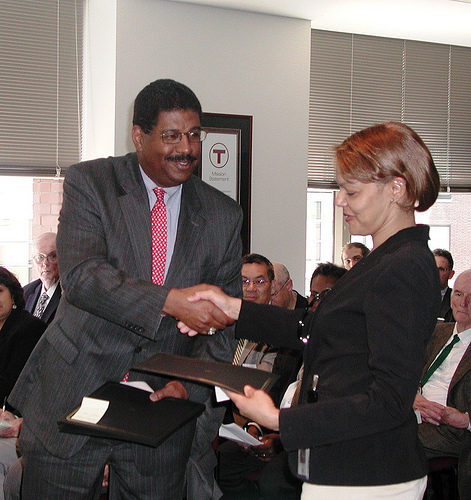
Engaging Mode of Leadership: Unlike styles of leadership can attain the leading function.
Dissimilar situations telephone call for unlike leadership styles. In an emergency, when there is little time to reach an agreement and where a designated say-so has significantly more than feel or expertise than the rest of the team, an autocratic leadership way may be nigh effective. However, in a highly motivated and aligned squad, with a homogeneous level of expertise, a more than democratic or laissez-faire style may be more effective. The leadership style adopted should be the one that most finer achieves the objectives of the grouping while balancing the interests of its private members.
Positive Reinforcement
Anyone thinking virtually managing a team must consider positive reinforcement. B.F. Skinner, the father of behavior modification, developed this concept. Positive reinforcement occurs when a positive stimulus is presented in response to a behavior, increasing the likelihood of that behavior in the future.
The following is an example of how positive reinforcement can be used in a business organization setting. Assume praise is a positive reinforcement for a particular employee. This employee does not show upward to piece of work on time every day. The manager of this employee decides to praise the employee for showing up on fourth dimension when the employee really does and so. As a result, the employee comes to work on time more often because the employee likes to be praised. In this example, praise (the stimulus) is a positive reinforcement for this employee because the employee arrives at piece of work on time (the behavior) more frequently later on being praised for information technology.
The use of positive reinforcement is a successful and growing technique used past leaders to motivate and attain desired behaviors from subordinates. Organizations, such as Frito-Lay, 3M, Goodrich, Michigan Bell, and Emery Air Freight, have all used reinforcement to increase productivity. Empirical research roofing the last 20 years suggests that reinforcement theory has a 17% increase in operation. Additionally, many reinforcement techniques, such as the employ of praise, are inexpensive and provide higher performance and employee satisfaction for lower costs.
Fulfilling the Planning Role
Planning is the process of thinking about and organizing the activities required to achieve strategic objectives.
Learning Objectives
Illustrate the primary considerations and influencing factors for organizations when pursuing strategic planning
Fundamental Takeaways
Key Points
- Planning involves the maintenance and organizational approach of achieving strategic objectives.
- To meet objectives, managers may develop plans such as a business plan or a marketing plan.
- Strategic planning is an organization 's procedure of defining its strategy or direction and making decisions almost how to allocate its resources to pursue this strategy.
- When pursuing strategic planning, organizations should inquire themselves what they practice, for whom practice they do it, and how they can excel (or differentiate from) competitors.
- The execution of the planning function requires a comprehensive understanding (or generation of) a vision, mission, set of values, and general strategy.
Key Terms
- strategy: A plan of action intended to accomplish a specific goal.
- allocating: The deed of distributing a given set of resources co-ordinate to a plan.
- forecasting: The human action of estimating hereafter outcomes.
Planning
Planning is the procedure of thinking well-nigh and organizing the activities required to achieve a desired goal. Planning involves the creation and maintenance of a given organizational operation. This thought process is essential to the refinement of objectives and their integration with other plans. Planning combines forecasting of developments with preparing scenarios for how to react to those developments. An important, albeit oftentimes ignored, aspect of planning is the relationship information technology holds with forecasting. Forecasting tin exist described as predicting what the future will look like, whereas planning predicts what the future should look like.
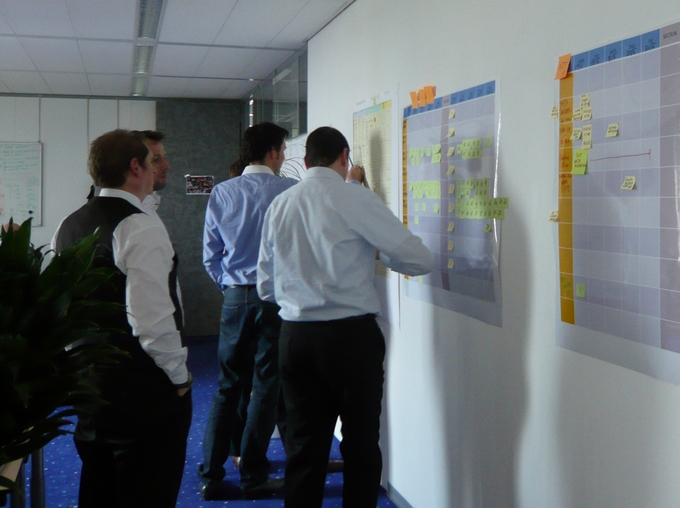
Research planning: Planning involves the creation and maintenance of a plan.
Planning is also a direction procedure, concerned with defining goals for a company's future direction and determining the missions and resources to achieve those targets. To meet objectives, managers may develop plans, such every bit a business plan or a marketing plan. The purpose may be achievement of sure goals or targets. Planning revolves largely around identifying the resources available for a given projection and utilizing optimally to accomplish best scenario outcomes.
Strategic Planning
Strategic planning is an organization's process of defining its strategy or direction and making decisions nearly allocating its resources to pursue this strategy. To determine the direction of the organization, information technology is necessary to sympathise its current position and the possible avenues through which it can pursue a particular class of activity. Generally, strategic planning deals with at least 1 of three key questions:
- What do we practise?
- For whom do we practice it?
- How practise nosotros excel?
The key components of strategic planning include an understanding of the firm'south vision, mission, values, and strategies. (Oftentimes a "vision statement" and a " mission statement " may encapsulate the vision and mission. )
- Vision: This outlines what the organisation wants to be or how information technology wants the world in which it operates to be (an "idealized" view of the world). Information technology is a long-term view and concentrates on the future. It can be emotive and is a source of inspiration. For example, a charity working with the poor might take a vision statement that reads "A Earth without Poverty."
- Mission: It defines the fundamental purpose of an organization or an enterprise, succinctly describing why it exists and what information technology does to achieve its vision. For example, the charity above might have a mission statement every bit "providing jobs for the homeless and unemployed."
- Values: These are beliefs that are shared amid the stakeholders of an organization. Values drive an organization'south culture and priorities and provide a framework in which decisions are fabricated. For example, "noesis and skills are the keys to success," or "requite a man breadstuff and feed him for a day, only teach him to farm and feed him for life." These example values place the priorities of self-sufficiency over shelter.
- Strategy: Strategy, narrowly defined, means "the art of the general"—a combination of the ends (goals) for which the business firm is striving and the means (policies) by which it is seeking to get there. A strategy is sometimes called a roadmap, which is the path chosen to move towards the end vision. The most important part of implementing the strategy is ensuring the company is going in the right management, which is towards the end vision.
Tools and Approaches
At that place are many approaches to strategic planning, but typically ane of the following is used:
- Situation-Target-Proposal: Situation – Evaluate the electric current situation and how information technology came nigh. Target – Define goals and/or objectives (sometimes chosen ideal country). Path/Proposal – Map a possible route to the goals/objectives.
- Draw-Encounter-Think-Plan: Draw – What is the platonic image or the desired end state? See – What is today'due south situation? What is the gap from ideal and why? Call back – What specific actions must be taken to close the gap between today's situation and the ideal state? Plan – What resources are required to execute the activities?
Among the most useful tools for strategic planning is a SWOT assay (Strengths, Weaknesses, Opportunities, and Threats). The main objective of this tool is to clarify internal strategic factors (strengths and weaknesses attributed to the organization) and external factors beyond command of the organization (such as opportunities and threats).
Source: https://courses.lumenlearning.com/boundless-management/chapter/principles-of-management/#:~:text=Management%20is%20the%20act%20of,accomplish%20desired%20goals%20and%20objectives.

Post a Comment for "Are Defined as the Art of Directing and Employing Resources to Achieve the Objectives"